
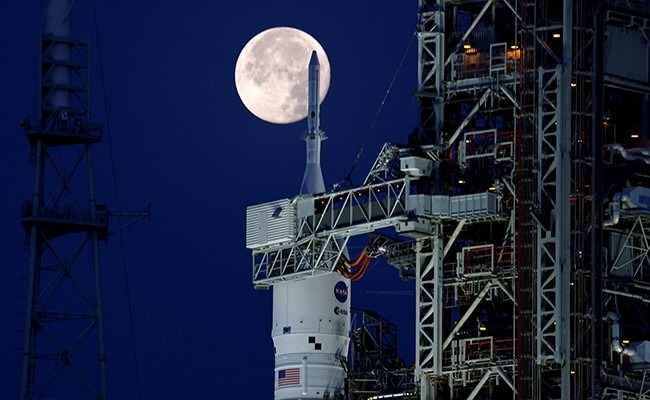
NASA’s historic unmanned Moon mission is facing new challenges.
After two launch attempts were cancelled due to technical issues several weeks ago, a new launch of the Artemis 1 mission scheduled for Tuesday is now threatened by a storm brewing in the Caribbean.
The storm, which has yet to be named, is currently positioned south of the Dominican Republic.
However, it is expected to strengthen into a hurricane in the coming days and could move north to Florida, which is home to the Kennedy Space Center, from which the rocket is scheduled to launch.
“Our plan A is to stay on course and launch on September 27,” Mike Bolger, NASA’s exploration ground systems manager, told reporters on Friday. “However, we realised that we also needed to pay close attention and plan B.”
This would entail wheeling the massive Space Launch System rocket back to the Vehicle Assembly Building, or VAB.
The orange and white SLS rocket on the launch pad can withstand wind gusts of up to 137 kilometres per hour. However, if it must be sheltered, the current launch window, which runs through October 4, will be missed.
Except for October 24-26 and 28, the next launch window will run from October 17 to 31, with one possible take-off per day.
After years of delays and cost overruns, a successful Artemis 1 mission would be a huge relief for the US space agency. However, another setback would be a blow to NASA, as two previous launches were cancelled due to technical issues, including a fuel leak.
The launch dates depend on NASA securing a special dispensation to avoid having to retest batteries on an emergency flight system that is meant to destroy the rocket if it deviates from its intended range and lands in a populated region.
The start of the launch window, which will last 70 minutes, is scheduled for Tuesday at 11:37 a.m. local time.
If the rocket launches that day, the mission will last 39 days before landing in the Pacific Ocean on November 5.
The Artemis 1 space mission aims to test the SLS as well as the unmanned Orion capsule that sits atop it in preparation for future Moon-bound journeys with humans aboard.
Sensor-equipped mannequins that will replace astronauts on the trip will measure radiation, vibration, and acceleration.
Artemis 2 will launch astronauts into orbit around the Moon without landing on its surface.
The crew of Artemis 3 is scheduled to land on the Moon no later than 2025.